

The Archive Was Empty
I opened Obsidian expecting to find the essay.

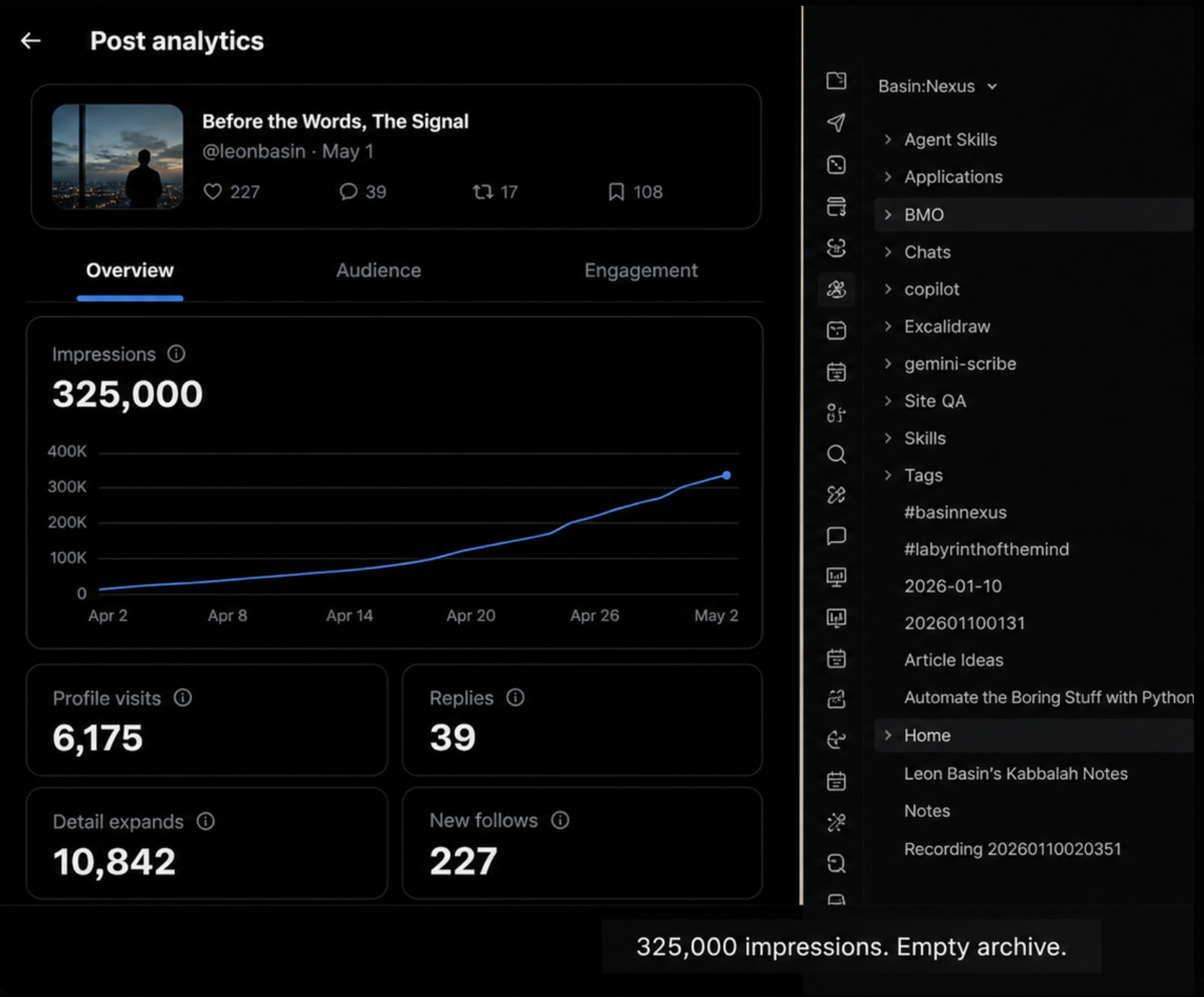
It had been a good week.
The piece had traveled farther than anything I had written in a long time. The analytics were still open in another tab. Hundreds of detail expands. Thousands of impressions. Replies from people I had never met.
I clicked into the archive.
Nothing.
I checked the folder again.
Still nothing.
For a moment I thought I had saved it somewhere else.
Drive. Drafts. Downloads. Desktop.
Nothing was missing.
The essay was everywhere. Just not in the one place designed to remember it.
I sat there longer than the problem required.
The fix was not difficult. Reconnect the service. Run the process again. Check that the file appeared where it was supposed to appear.
I have fixed versions of this problem for years.
A Salesforce opportunity is missing the conversation that changed the deal. A handoff happened, but the reason behind it did not make the crossing. A customer said no, somebody selected a field from a dropdown, and six months later the database remembers the answer but not what the answer meant.
Systems are good at recording that something happened.
They are less reliable at remembering what happened.
The essay had begun with a cafeteria.
When I arrived in America at nine years old, I learned to read the room before I could read the menu. I watched what other children ordered. I listened for the safe words. I learned which mistakes would pass unnoticed and which ones would turn every face toward me.
That was the story people had found.
Not my thoughts about immigration. Not a theory about language. A child in a cafeteria trying to understand the rules before anyone noticed he did not know them.
The analytics showed that people had stopped to read it. The archive did not.
It knew nothing about the cafeteria. Nothing about the opening line. Nothing about the people who replied with their own versions of arriving somewhere before they understood it.
The archive did not even know the essay existed.
I had spent weeks building the machinery around my writing.
One tool collected fragments from different places. Another read drafts and flagged the moment I stopped revealing something and started performing. Another was supposed to file the finished work into my vault and Drive. A final layer checked whether the other parts had done what they claimed to do.
Most of it worked.
The writing moved. The post published. The analytics arrived.
Then one connector failed quietly, and the chain continued as if nothing had happened.
That was the part I could not stop looking at.
Failure usually makes noise. An error appears. A screen turns red. Something refuses to continue.
This failure looked like success.
The essay was live. The numbers were climbing. The system had moved on.
Only the empty folder told the truth.
I think builders are trained to notice what moves.
The send.
The launch.
The reply.
The number changing on the screen.
We build for production because production is visible. It gives us receipts. A thing was made. A task completed. A graph went up.
Preservation is quieter.
Nothing happens when it works. The file is simply there when you return. The note carries the sentence you had forgotten. The record contains enough context for someone who was not in the room. The story survives the platform where it first appeared.
You notice preservation only when it fails.
I thought about how much of the internet now depends on machines that can produce without remembering.
They answer, summarize, generate, and move on. A new response replaces the last one. A feed refreshes. A conversation disappears below the fold. We are creating more language than at any point in history while becoming less certain where any of it belongs.
The problem is not that the machines forget.
People do too.
Companies forget why a decision was made after the people who made it leave. Families repeat stories until the details become smooth. Writers remember the published piece and lose the note that made it possible. We keep the outcome and misplace the conditions that produced it.
The number remains.
The meaning leaks out.
I have seen this problem before.
Different tools. Different decade. Same disappearance.
At some point that night, the empty folder stopped looking like a technical failure.
It looked like a warning.
I had built a system capable of helping me make more work. That was the easy part. The harder question was whether the work would remain connected to the life that produced it.
Could the cafeteria stay attached to the analytics?
Could the sentence stay attached to the day it arrived?
Could a future version of me open the vault and find more than a finished article?
Not just what I wrote.
What happened.
I restarted the connector.
The file appeared.
Title. Date. Link. A short note about where the piece began. The line I wanted to keep. The numbers that showed how far it traveled.
The archive was no longer empty.
But I did not feel relieved in the way I expected.
The technical problem had been fixed. The larger one had only become visible.
Making something is not the same as keeping it.
Publishing something is not the same as remembering it.
And reach is not proof that anything will remain.
One essay reached 325,000 people.
For a few hours, the place I built to remember it had no idea it existed.
The internet had the story.
I almost did not.